
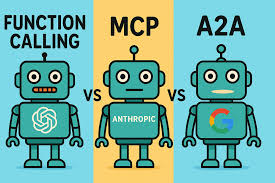
Artificial Intelligence is evolving at breakneck speed, and the latest developments are redefining how machines access knowledge, reason, and collaborate. From the static knowledge of Large Language Models (LLMs) to the dynamic, collective intelligence of Agent-to-Agent (A2A) protocols, each step marks a leap forward in AI’s capabilities.
Here’s a look at this fascinating progression — what each stage means, what it can do, and how it compares to familiar real-world analogies.
📚 LLMs: The Starting Point
Knowledge Access: Fixed knowledge from pretraining; cannot update or retrieve new data after deployment.
Intelligence: Basic pattern recognition.
Capabilities: Text generation, pattern matching, limited reasoning.
Analogy: Like reading a printed book — all information is static, with no updates.
🔍 RAG: Retrieval-Augmented Generation
Knowledge Access: Pulls external content to enhance outputs with up-to-date information.
Intelligence: Reactive with limited logic.
Capabilities: Combines LLM output with real-time external data.
Analogy: Like Googling before answering a question.
⚙️ Tool or Function Calling
Knowledge Access: Uses APIs and tools to access real-time knowledge.
Intelligence: Task-oriented logic.
Capabilities: Executes external functions, performs actions via APIs.
Analogy: Like using a calculator or calendar app to get something done.
🤖 AI Agents
Knowledge Access: Interacts dynamically with tools and environments to gather knowledge.
Intelligence: Goal-driven and adaptive.
Capabilities: Planning, decision-making, task orchestration.
Analogy: Like a personal assistant deciding how to complete your tasks.
🔬 Agentic RAG
Knowledge Access: Independently finds and filters optimal external data.
Intelligence: Self-reliant decision-maker.
Capabilities: Information synthesis, autonomous task completion.
Analogy: Like a researcher who selects the best articles to solve a problem.
🧠 Graph RAG
Knowledge Access: Uses structured knowledge graphs for context-aware reasoning.
Intelligence: Context-aware reasoning.
Capabilities: Relational and causal understanding, knowledge traversal.
Analogy: Like using a mind map to see how ideas connect.
🤝 Multi-agent Systems
Knowledge Access: Multiple agents share and coordinate knowledge.
Intelligence: Collaborative intelligence.
Capabilities: Distributed planning, parallel execution, teamwork.
Analogy: Like a team of experts each handling a part of a project.
📏 MCP: Model Context Protocol
Knowledge Access: Accesses shared, standardized knowledge across agents and tools.
Intelligence: System-level cognition.
Capabilities: Context harmonization, semantic alignment.
Analogy: Like a team sharing one master notebook in real time.
🤖➡️🤖 A2A: Agent-to-Agent Protocol
Knowledge Access: Autonomous agents communicate, reason, and learn together.
Intelligence: Autonomous collective intelligence.
Capabilities: Inter-agent negotiation, learning, and zero-human collaboration.
Analogy: Like teammates discussing and solving problems without a manager.
🌟 Why This Evolution Matters
The shift from static, isolated LLMs to dynamic, collaborative AI systems represents a fundamental transformation. By enabling real-time reasoning, external tool integration, and inter-agent communication, we’re paving the way for AI systems that act more like teams of experts — capable of tackling complex problems with minimal human input.
💡 Final Thoughts
As we move toward A2A protocols, the potential applications multiply: imagine intelligent networks of AI assistants working together seamlessly, from healthcare diagnostics to autonomous supply chains. The future of AI isn’t just smarter models — it’s smarter systems working together

