
Artificial Intelligence feels like it arrived overnight.
One moment we were talking about automation and dashboards.
The next, machines are writing, drawing, reasoning, and acting.
But this moment wasn’t sudden.
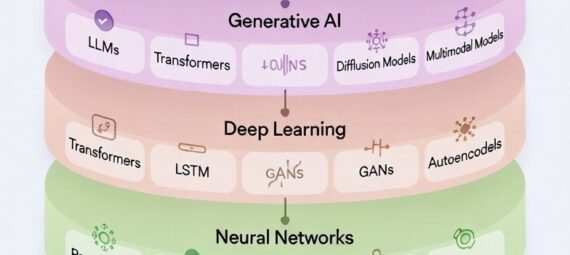
What we are experiencing today is the visible peak of decades of layered progress, quietly accumulating beneath the surface. AI is not a single breakthrough—it is a stack of building blocks, each solving different classes of problems, each still relevant.
That distinction matters. Because real value from AI does not come from adopting everything. It comes from choosing the right layer for the right problem.
The AI Stack: How We Actually Got Here
1. Classical AI: Rules Without Learning
At the foundation lies classical (symbolic) AI.
These systems operate on explicit, human-defined rules:
-
If X happens, do Y
-
If condition A and B are true, approve the transaction
You’ll still find this layer everywhere:
-
Insurance eligibility checks
-
Banking compliance engines
-
Workflow automation and decision trees
They are predictable, auditable, and controllable—which is exactly why they remain essential in regulated environments.
But they are also brittle.
When the world changes, the rules must be rewritten.
2. Machine Learning: Data Replaces Rules
Machine learning marked the first major shift.
Instead of hardcoding logic, we let data drive decisions.
Patterns replace assumptions. Probabilities replace certainties.
This layer quietly powers:
-
Sales and demand forecasting
-
Credit scoring and fraud detection
-
Customer churn prediction
-
Risk stratification in healthcare
ML systems are narrow but powerful. They excel when the problem is well-defined and historical data is available—but they don’t generalise or reason beyond their training scope.
Still, for optimisation and prediction, this layer remains the backbone of enterprise AI.
3. Neural Networks: Letting Models Decide What Matters
Neural networks changed how features were handled.
Instead of manually selecting what matters, we let the model learn representations from raw data.
This unlocked messy, high-dimensional inputs:
-
Images
-
Audio
-
Sensor data
-
Free text
Suddenly, use cases that once felt impossible became routine:
-
Image recognition for quality inspection
-
Speech-to-text in call centres
-
Pattern detection in medical signals
This was less about better accuracy—and more about expanding what machines could process at all.
4. Deep Learning: Scale Changes Everything
Deep learning arrived when data, compute, and algorithms aligned.
Depth and scale transformed performance:
-
Vision systems surpassed human-level accuracy in some domains
-
Transformers revolutionised language understanding
-
Multimodal models began connecting text, images, audio, and video
This is where progress stopped being incremental.
Computers started seeing defects humans miss.
Language models stopped sounding robotic.
AI moved from “interesting” to “usable at scale”.
5. Generative AI: The Public Inflection Point
Generative AI is not the beginning of AI—but it is the moment AI became visible.
For the first time:
-
AI could write reports
-
Draft code
-
Create images
-
Summarise complex information
Not perfectly.
But well enough to change behaviour.
Generative AI accelerated thinking, creation, and iteration. It didn’t replace expertise—but it reduced friction everywhere knowledge work exists.
That’s why everything suddenly feels different.
6. Agentic AI: From Answers to Action
This is the newest—and most misunderstood—layer.
Generative AI answers questions.
Agentic AI executes tasks.
Agentic systems combine:
-
Memory
-
Planning
-
Tool use
-
Feedback loops
-
Autonomy
They behave less like models and more like junior employees:
-
Monitoring systems
-
Triggering workflows
-
Coordinating multi-step processes
-
Acting on goals, not just prompts
Whether this shift is underestimated or overhyped depends on one thing:
the strength of the layers beneath it.
The Insight That Actually Matters
Every layer in this stack still matters.
Not every organisation needs agentic AI today.
Not every problem requires generative AI.
-
Rule-based systems still anchor compliance and governance
-
Machine learning drives forecasting and optimisation
-
Neural networks and deep learning handle scale and complexity
-
Generative AI accelerates creativity and cognition
-
Agentic AI orchestrates work when foundations are strong
AI success is not about chasing the top of the stack.
source: Clare Kitching LinkedIn Post
https://www.linkedin.com/feed/update/urn:li:activity:7415305081882845184/

